


Pocket Watch Terminology
A glossary of the words, mechanisms and materials that make up the language of pocket watchmaking — from acrylic crystal to zodiac. Jump to any letter using the ring above, or read straight through.
A
- Acrylic Crystal
- The inexpensive plastic crystal. It's not very hard and shallow scratches can be buffed out.
- Alarm Watch
- A watch provided with a movement capable of releasing an acoustic sound at the time set. A second crown is dedicated to the winding, setting and release of the striking-work; an additional center hand indicates the time set. The section of the movement dedicated to the alarm device is made up by a series of wheels linked with the barrel, an escapement and a hammer striking a gong or bell. Works much like a normal alarm clock.
- Amplitude
- Maximum angle by which a balance or pendulum swings from its rest position.
- Analog or Analogue
- A watch displaying time indications by means of hands.
- Analog Quartz
- The most commonly-used term in referring to any analog timepiece that operates on a battery or on solar power and is regulated by a quartz crystal.
- Annual Calendar
- See Calendar, Annual.
- Antimagnetic
- Said of a watch whose movement is not influenced by electromagnetic fields that could cause two or more windings of the balance-spring to stick to each other, consequently accelerating the rate of the watch. This effect is obtained by adopting metal alloys (e.g. Nivarox) resisting magnetization.
- Antireflection, Antireflective
- Superficial glass treatment assuring the dispersion of reflected light. Better results are obtained if both sides are treated, but in order to avoid scratches on the upper layer, the treatment of the inner surface is preferred.
- Arbor
- Bearing element of a gear or balance, whose ends — called pivots — run in jewel holes or brass bushings.
- Atmosphere (ATM)
- Unit of pressure used in watch making to indicate water-resistance.
- Atomic Time Standard
- Provided by the U.S. National Institute of Standards and Technology, Time and Frequency Division, Boulder, Colorado, atomic time is measured through vibrations of atoms in a metal isotope that resembles mercury. The result is extremely accurate time that can be measured on instruments. Radio waves transmit this exact time throughout North America and some “atomic” watches can receive them and correct to the exact time.
- Automatic
- A watch whose mechanical movement is wound automatically. A rotor makes short oscillations due to the movements of the wrist. Through a series of gears, oscillations transmit motion to the barrel, thus winding the mainspring progressively.
- Automatic Winding
- A rotating weight, set into motion by moving the wrist, winds the going barrel via the gear train of a mechanical watch movement. Automatic winding was invented during the pocket watch era in 1770 by Abraham-Louis Perrelet, who created a watch with a weight swinging to and fro (when carried in a vest pocket, a pocket watch usually makes vertical movements). The first automatic winding wristwatches, invented by John Harwood in the 1920s, utilized so-called hammer winding, whereby a weight swung in an arc between two banking pins. The breakthrough automatic winding movement via rotor began with the ball bearing Eterna-Matic in the late 1940s, and the workings of such a watch haven't changed fundamentally since. Today we speak of unidirectional winding and bi-directionally winding rotors, depending on the type of gear train used.
- Automaton
- Figures, placed on the dial or case of watches, provided with parts of the body or other elements moving at the same time as the sonnerie strikes. The moving parts are linked, through an aperture on the dial or caseback, with the sonnerie hammers striking a gong.
B
- Baguette
- Ladies style watch with a thin, elongated face; usually rectangular in shape but may be oval.
- Balance
- Oscillating device that, together with the balance spring, makes up the movement's heart in as much as its oscillations determine the frequency of its functioning and precision.
- Balance Spring
- Component of the regulating unit that, together with the balance, determines the movement's precision. The material used is mostly a steel alloy (e.g. Nivarox), an extremely stable metal compound. In order to prevent the system's center of gravity from continuous shifts, hence differences in rate due to the watch's position, some modifications were adopted. These modifications included Breguet's overcoil (closing the terminal part of the spring partly on itself, so as to assure an almost perfect centering) and the Philips curve (helping to eliminate the lateral pressure of the balance-staff pivots against their bearings). Today, thanks to the quality of materials, it is possible to assure an excellent precision of movement even with a flat spring.
- Barrel
- Component of the movement containing the mainspring, whose toothed rim meshes with the pinion of the first gear of the train. Because the whole movement — made up of barrel and mainspring — transmits the motive force, it is also considered to be the very motor. Inside the barrel, the mainspring is wound around an arbor turned by the winding crown or, in automatic movements, also by the gear powered by the rotor.
- Base Metal
- Any non-precious metal.
- Battery
- Device that converts chemical energy into electricity. Most watch batteries are silver oxide type delivering 1.5 volts. Much longer-lasting lithium batteries are 3 volt.
- Battery Life
- The minimum period of time that a battery will continue to provide power to run the watch. Life begins at the point of manufacture when the factory initially installs the battery.
- Battery Reserve Indicator
- Some battery-operated watches have a feature that indicates when the battery is approaching the end of its life, often shown by the second hand moving in two-second intervals instead of each second.
- Bearing
- Part on which a pivot turns; in watches it is represented mostly by jewels.
- Beveling
- Chamfering of edges of levers, bridges and other elements of a movement by 45°, a treatment typically found in high-grade movements.
- Bezel
- Top part of the case, often shaped as the ring surrounding the watch face, sometimes holding the crystal. It may be integrated with the case middle or may be a separate element, snapped or screwed on to the middle.
- Bracelet
- A metal band attached to the case. It is called integral if there is no apparent discontinuity between case and bracelet and the profile of attachments is similar to the first link.
- Bridge
- Structural metal element of a movement — sometimes called cock or bar — supporting the wheel train, balance, escapement and barrel. Each bridge is fastened to the plate by screws and locked in position by pins. In high-quality movements the sight surface is finished with various types of decoration.
- Brushed, Brushing
- Topical finishing giving metals a line finish, a clean and uniform look.
- Buckle
- Usually matching the case, it attaches the two parts of the leather strap around the wrist.
- Button
- Push piece controls, usually at 2 o'clock and/or 4 o'clock on the dial, to control special functions such as the chronograph or the alarm.
C
- Cabochon
- Any kind of precious stone, such as sapphire, ruby or emerald, uncut and only polished, generally of a half-spherical shape, mainly used as an ornament of the winding crown or certain elements of the case.
- Calendar, Annual
- An intermediate complication between a simple calendar and a perpetual calendar. This feature displays all the months with 30 or 31 days correctly, but needs a manual correction at the end of February. Generally, date, day of the week and month, or only day and month, are displayed on the dial.
- Calendar, Full
- Displaying date, day of the week and month on the dial, but needing a manual correction at the end of a month with fewer than 31 days. It is often combined with the moonphase.
- Calendar, Perpetual
- The most complex horology complication related to the calendar feature, as it indicates the date, day, month and leap year and does not need manual corrections until the year 2100 (when the leap year will be ignored).
- Caliber
- Originally indicated only the size of a movement, but now this indication defines a specific movement type and shape (e.g. round caliber) combined with the constructor's name and identification number. The caliber identifies the movement.
- Cannon
- An element in the shape of a hollow cylinder, sometimes also called pipe or bush, for instance the pipe of the hour wheel bearing the hour hand.
- Carat (Karat)
- Unit of gold fineness (and gemstone weight). Pure gold is 24k. 18k gold is 75% pure.
- Carousel
- Device similar to the tourbillon, but with the carriage driven not by the fourth wheel but by the third wheel.
- Carriage or Tourbillon Carriage
- Rotating frame of a tourbillon device, carrying the balance and escapement. This structural element is essential for a perfect balance of the whole system and its stability, despite its reduced weight. As today's tourbillon carriages make a rotation per minute, errors of rate in the vertical position are eliminated. Because of the widespread use of transparent dials, carriages became elements of aesthetic attractiveness.
- Case
- Container housing and protecting the movement, usually made up of three parts: middle, bezel, and back.
- Center Second Hand
- See Sweep Second Hand.
- Center-Wheel
- The minute wheel in a going-train.
- Champlevé
- Hand-made treatment of the dial or case surface. The pattern is obtained by hollowing a metal sheet with a graver and subsequently filling the hollows with enamel.
- Chapter-Ring
- Hour-circle, i.e. the hour numerals arranged on a dial.
- Chime
- Striking-work equipped with a set of bells that may be capable of playing a complete melody. A watch provided with such a feature is called a chiming watch.
- Chronograph
- A watch that includes a built-in stopwatch function, i.e. a timer that can be started and stopped to time an event. There are many variations of the chronograph.
- Chronometer
- A high-precision watch. According to Swiss law, a manufacturer may put the word “chronometer” on a model only after each individual piece has passed a series of tests and obtained a running bulletin and a chronometer certificate by an acknowledged Swiss control authority, such as the COSC.
- Circular Graining
- Superficial decoration applied to bridges, rotors and pillar-plates in the shape of numerous slightly superposed small grains, obtained using a plain cutter and abrasives. Also called Pearlage or Pearling.
- Clasp
- The attachment used to connect the two ends of the watch bracelet or strap around the wrist, with several common variants:
- Cloisonné
- A kind of enamel work — mainly used for the decoration of dials — in which the outlines of the drawing are formed by thin metal wires. The colored enamel fills the hollows formed in this way. After oven firing, the surface is smoothed until the gold threads appear again.
- Clous de Paris
- Decoration of metal parts characterized by numerous small pyramids.
- Cock
- See Bridge.
- Colimaçonnage
- See Snailing.
- Column-Wheel
- Part of chronograph movements, governing the functions of various levers and parts of the chronograph operation, in the shape of a small-toothed steel cylinder. It is controlled by pushers through levers that hold and release it. It is a very precise and usually preferred type of chronograph operation.
- Complication
- Additional function with respect to the manual-winding basic movement for the display of hours, minutes and seconds. Today, certain features, such as automatic winding or date, are taken for granted, although they should be defined as complications. The main complications are moonphase, power reserve, GMT, and full calendar. Further functions are performed by the so-called great complications, such as split-second chronograph, perpetual calendar, tourbillon device, and minute repeater.
- Corrector
- Pusher positioned on the case side that is normally actuated by a special tool for the quick setting of different indications, such as date, GMT, full or perpetual calendar.
- COSC
- Abbreviation of “Contrôle Officiel Suisse des Chronomètres,” the most important Swiss institution responsible for the functioning and precision tests of chronometer movements. Tests are performed on each individual watch at different temperatures and in different positions before a functioning bulletin and a chronometer certificate are issued, for which a maximum gap of -4..+4 seconds per day is tolerated.
- Côtes Circulaires
- Decoration of rotors and bridges of movements, whose pattern consists of a series of concentric ribs.
- Côtes de Genève
- Decoration applied mainly to high-quality movements, appearing as a series of parallel ribs, realized by repeated cuts of a cutter leaving thin stripes.
- Countdown Timer
- A function that lets the wearer keep track of how much of a pre-set period of time has elapsed. Some countdown timers sound a warning signal a few seconds before the time runs out. These are useful in events such as races.
- Counter
- Additional hand on a chronograph, indicating the time elapsed since the beginning of the measuring. On modern watches the second counter is placed at the center, while minute and hour counters have off-center hands in special zones, also called subdials.
- Crown
- Usually positioned on the case middle, it allows winding, hand setting and often date or GMT hand setting, and is linked to the movement through the winding stem passing through a hole in the case. For waterproofing, simple gaskets are used in water-resistant watches, while diving watches adopt screwing systems (screw-down crowns).
- Crown Wheel
- Wheel meshing with the winding pinion and with the ratchet wheel on the barrel-arbor.
- Crystal
- The clean cover over the watch face. Three types of crystals are commonly found in watches: acrylic crystal, mineral crystal and sapphire crystal.
Deployment BuckleA three-folding enclosure, which secures the two ends of the bracelet and allows enough room for placing the watch on the wrist when fully deployed. When closed, the buckle covers the two-piece folding mechanism.
Hook LockTwo separate units, each fitting on either end of the bracelet, allow the watch to be laid out. One end of the closure hooks onto the other to secure the two ends of the bracelet.
Jeweler's ClaspA closure generally used on better bracelets, also allowing it to lie flat.
Sliding ClaspAlso a hook-type method, but allows for easy sizing of the bracelet by sliding up.
Twist LockA closure similar to the Jeweler's Clasp, used on ladies' jewelry bracelets.
D
- Deck Watch
- A large-sized ship's chronometer.
- Depth Alarm
- An alarm on a diver's watch that sounds when the wearer exceeds a pre-set depth.
- Depth Meter or Depth Sensor
- A device on a diver's watch that determines the wearer's depth by measuring water pressure. It shows the depth either by analog hands and a scale on the watch face or through a digital display.
- Deviation
- A progressive natural change of a watch's rate with respect to objective time. In case of a watch's faster rate, the deviation is defined as positive, in the opposite case negative.
- Dial
- Face of a watch, on which time and further functions are displayed by markers, hands, discs or through windows. Normally made of brass — sometimes silver or gold.
- Digital Watch
- Said of watches whose indications are displayed mostly inside an aperture or window on the dial.
- Divers' Watch
- A watch that is water resistant to 200M. Has a unidirectional rotating bezel and a screw-on crown and back. Has a metal or rubber strap (not leather). May have a sapphire crystal and possibly a wet-suit extension.
E
- Ebauche
- Incomplete (jeweled or non-jeweled) watch movement without regulating organs, mainspring, dial and hands.
- Eco-Drive
- A name for a patented power mechanism found on some Citizen watches. This mechanism uses ordinary light to keep a rechargeable battery powered for watch operation, allowing some models to remain powered for up to 5 years in the dark. Watches with Eco-Drive technology will never need to have the battery replaced.
- Elapsed Time Rotating Bezel
- A graduated rotating bezel used to keep track of elapsed time. The bezel can be turned so the wearer can align the zero on the bezel with the watch's seconds or minutes hand. After a period of time passes, the elapsed time can be read off the bezel, saving the subtraction that would otherwise be necessary.
- Electroplating Process
- Process of covering metal articles with a film of other metals. The article is immersed in a chemical solution; electric current (D.C.) flows through the solution from a piece of metal (anode) to the article (cathode), depositing metal thereon by electrolysis.
- Endstone
- Undrilled jewel, placed on the balance jewel with the tip of the balance-staff pivot resting against its flat surface, to reduce pivot friction. Sometimes used also for pallet staffs and escape wheels.
- Engine-Turned
- See Guilloché.
- Equation of Time
- Indication of the difference, expressed in minutes, between conventional mean time and real solar time. This difference varies between one day and the other.
- Equinox
- The time when day and night are of equal length, when the sun is on the plane of the equator. Such times occur twice a year: the vernal equinox around March 21st–22nd and the autumnal equinox around September 22nd–23rd.
- Escapement
- Positioned between the train and the balance wheel, governing the rotation speed of the wheel-train wheels. In today's horology the most widespread escapement type is the lever escapement. In the past, numerous types of escapements were used, such as verge, cylinder, pin-pallet, detent and duplex escapements. More recently, George Daniels developed a so-called “coaxial” escapement.
- Escape Wheel
- A wheel belonging to the mechanism called the escapement.
F
- Flange
- The usually inclined ring that separates the crystal from the dial. The flange is sometimes equipped with features such as tachymetric scales and pulsometers.
- Flinqué
- Engraving on the dial or case of a watch, covered with an enamel layer.
- Fluted
- Said of surfaces worked with thin parallel grooves, mostly on dials or case bezels.
- Fly-Back
- Feature combined with chronograph functions that allows a new measurement to start from zero (interrupting a measurement already under way) by pressing a single pusher, without needing to stop, zero and restart the whole mechanism separately. Originally developed to meet the needs of air forces.
- Fold-Over Clasp
- Hinged and jointed element, normally of the same material as the case, allowing easy fastening of the bracelet on the wrist. Often provided with a snap-in locking device, sometimes with an additional clip or push-piece.
- Fourth Wheel
- The seconds wheel in the going-train.
- Frequency
- Generally defined as the number of cycles per time unit; in horology it is the number of oscillations of a balance every two seconds or of its vibrations per second, expressed in vibrations per hour (vph). See also Vibration.
- Fusee
- A conical part with a spiral groove on which a chain or cord attached to the barrel is wound. Its purpose is to equalize the driving power transmitted to the train.
G
- Geneva Seal
- See Poinçon de Geneve.
- Glass
- Thin plate of glass or transparent synthetic material, for protecting the dial of the watch. See also Crystal.
- Glucydur
- Bronze and beryllium alloy used for high-quality balances. This alloy assures high elasticity and hardness values; it is non-magnetic, rustproof and has a very reduced dilatation coefficient, making the balance very stable and assuring high accuracy of the movement.
- GMT
- Abbreviation for Greenwich Mean Time. As a feature of watches, it means that two or more time zones are displayed. The second time may be read from a hand making a full rotation in a 24-hour ring (thereby also indicating whether it is a.m. or p.m. in that zone).
- Gong
- Harmonic flattened bell in a steel alloy, generally positioned along the circumference of the movement and struck by hammers to indicate time by sounds. Size and thickness determine the resulting note and tone. Watches with minute-repeaters often have two gongs, and more complex models with en-passant sonnerie devices may have up to four gongs producing different notes and even playing simple melodies (such as the chime of London's Big Ben).
- Guilloché
- Decoration of dials, rotors or case parts consisting of patterns made by hand or engine-turned. The thin pattern of crossing or interlaced lines makes it possible to realize even complex drawings. Dials and rotors decorated in this way are generally in gold or solid silver.
H
- Hammer
- Steel or brass element used in movements provided with a repeater or alarm sonnerie. It strikes a gong or bell.
- Hand
- Indicator for the analogue visualization of hours, minutes and seconds as well as other functions. Normally made of brass (rhodium-plated, gilded or treated otherwise), but also steel or gold. Hands are available in different shapes and take part in the aesthetic result of the whole watch.
- Hardlex Crystal
- Seiko's trademarked name for a hardened mineral crystal.
- Heart-Piece
- Heart-shaped cam, generally used to realign the hands of chronograph counters.
- Helium Valve
- Valve inserted in the case of some professional diving watches to discharge the helium contained in the air mixture inhaled by divers.
- Hexalite
- An artificial glass made of a plastic resin, once common alongside mineral glass and acrylic crystals. Now most luxury watches use highly scratch-resistant synthetic sapphire crystals, though some styles/brands still use Hesalite (a fine acrylic crystal) for its resistance to shattering — important for certification in space or high-impact environments, since sapphire, though harder, can shatter into hazardous fragments.
- Hunter Caliber
- A caliber characterized by the seconds hand fitted on an axis perpendicular to that of the winding stem.
I
- Incabloc
- See Shockproof.
J
- Jewel
- Precious stone used in movements as a bearing surface. Generally speaking, the steel pivots of wheels in movements turn inside synthetic jewels (mostly rubies) lubricated with a drop of oil. The jewel's hardness reduces wear to a minimum even over long periods of time (50 to 100 years). The quality of watches is determined mainly by the shape and finishing of jewels rather than by their number.
- Jumping Hour
- Feature concerning the digital display of time in a window. The indication changes almost instantaneously at every hour.
K
- Kinetic
- Refers to the Seiko line of Kinetic watches. This technology has a quartz movement that does not use a battery; movement of the wrist charges a very efficient capacitor which powers the quartz movement. Once fully charged, men's models store energy for 7–14 days and ladies' models for 3–7 days without being worn. The watch alerts the owner to a low charge when the seconds hand starts to move in two-second intervals. Some Kinetic watches have see-through casebacks, using a clear Hardlex crystal to enable the wearer to view the movement.
- Kinetic Auto Relay
- A Seiko Kinetic Auto Relay watch is powered by human movement; however, when it senses inactivity for three days, it puts itself into suspended animation to conserve energy. It can be re-activated with a few shakes of the wrist and automatically resets itself to the exact time after up to four years of dormancy.
L
- Lap Timer
- A chronograph function that lets the wearer time segments of a race. At the end of a lap, the timer is stopped, then returns to zero to begin timing the next lap.
- Leap-Year Cycle
- Leap or bissextile years have 366 days and occur every 4 years (with some exceptions — see Calendar, Gregorian). Some watches display this datum.
- Lepine Caliber
- A caliber typical of pocket watches, characterized by the seconds hand fitted in the axis of the winding stem.
- Line
- Ancient French measuring unit maintained in horology to indicate the diameter of a movement. A line equals 2.255mm. Lines are not divided into decimals; fractions are used to indicate measures below the unit.
- Liquid Crystal Display (LCD)
- A digital watch display that shows the time electronically by means of a liquid held in a thin layer between two transparent plates. All LCD watches have quartz movements.
- Lubrication
- Reduces friction caused by the running of wheels and other parts. Specific low-density oils lubricate points such as the pivots turning inside jewels and the sliding areas between levers, while the spring inside the barrel requires a special grease, along with numerous other parts of a movement.
- Lug
- Double extension of the case middle by which a strap or bracelet is attached. Normally, straps and bracelets are attached with removable spring bars.
- Luminescent or Luminous
- Said of materials applied on markers and/or hands, emitting the luminous energy previously absorbed as electromagnetic light rays. Tritium is no longer used and was replaced by substances with the same emitting powers but virtually zero radioactivity, such as Super-LumiNova and Lumibrite.
M
- Mainspring
- This and the barrel make up the driving element of a movement. It stores and transmits the power force needed for its functioning.
- Manual
- A mechanical movement in which winding is performed by hand. The motion transmitted from the user's fingers to the crown is forwarded to the movement through the winding stem, from this to the barrel through a series of gears and finally to the mainspring.
- Marine Chronometer
- A large-sized chronometer watch enclosed in a box (therefore also called a box chronometer), mounted on gimbals and used on board ships to determine longitude.
- Markers
- Elements printed or applied on the dial, sometimes luminescent, used as reference points for the hands to indicate hours and fifteen- or five-minute intervals.
- Meantime
- The mean time of the meridian of the Greenwich Observatory, considered the universal meridian, used as a standard of the civil time system, counted from midnight to midnight.
- Measurement Conversion
- A feature, usually consisting of a graduated scale on the watch's bezel, that lets the wearer translate one type of measurement into another — miles into kilometers, for instance, or pounds into kilograms.
- Mechanical Movement
- A movement powered by a mainspring, working in conjunction with a balance wheel. Most watches today have electronically controlled quartz movements powered by a battery; mechanical watches are currently enjoying a resurgence in popularity.
- Micrometer Screw
- Element positioned on the regulator, allowing it to be shifted by minimal and perfectly gauged ranges so as to obtain accurate regulation of the movement.
- Micro-Rotor
- See Rotor.
- Military Time or 24-Hour Time
- When time is measured in 24-hour segments. To convert 12-hour time into 24-hour time, add 12 to any p.m. time; to convert 24-hour time into 12-hour time, subtract 12 from any time from 13 to 24.
- Mineral Crystal or Mineral Glass
- Watch crystal that has been tempered (heat treated) to increase its hardness and scratch resistance.
- Minute Repeater
- See Repeater.
- Module
- Self-contained mechanism, independent of the basic caliber, added to the movement to make an additional function available: chronograph, power reserve, GMT, perpetual or full calendar.
- Moonphase
- A function available in many watches, usually combined with calendar-related features. The moonphase disc advances one tooth every 24 hours; with 59 teeth, it assures an almost perfect synchronization with the lunation period of 29.53 days. The small remaining difference means a manual adjustment is needed every two and a half years to recover one day. In rare cases, the gear ratio is calculated with such accuracy that manual correction is required only once in 100 years.
- Mother of Pearl
- Iridescent, milky interior shell of the fresh water mollusk that is sliced thin and used on watch dials. While most have a milky white luster, mother-of-pearl also comes in other colors such as silvery gray, gray blue, pink, and salmon.
- Movement
- The entire mechanism of a watch. Movements are divided into two great families: quartz and mechanical; the latter are available with manual or automatic winding devices.
N
- Nivarox
- Trade name (from the producer's name) of a steel alloy resisting magnetization, used for modern self-compensating balance springs. The quality level of this material is indicated by the numeral following the name, in decreasing value from 1 to 5.
O
- Observatory Chronometer
- An observatory-tested precision watch that obtained the relevant rating chronometer certificate.
- Oscillation
- Complete oscillation or rotation movement of the balance, formed by two vibrations.
P
- Pallets
- Device of the escapement transmitting part of the motive force to the balance, maintaining the amplitude of oscillations unchanged by freeing a tooth of the escape wheel at a time.
- Perpetual Calendar
- See Calendar, Perpetual.
- Pillar-Plate or Main Plate
- Supporting element of bridges and other parts of a movement.
- Pinion
- Combines with a wheel and an arbor to form a gear. A pinion has fewer teeth than a wheel and transmits motive force to a wheel. Pinion teeth (normally 6 to 14) are highly polished to reduce friction to a minimum.
- Pivot
- End of an arbor turning on a jewel support. Because their shape and size can influence friction, the pivots of the balance-staff are particularly thin and hence fragile, so they are protected by a shockproof system.
- Plated
- Metal treated by a galvanizing procedure in order to apply a slight layer of gold or another precious metal (silver, chromium, rhodium or palladium) onto a brass or steel base.
- Plexiglas
- A synthetic resin used for watch crystal.
- Poinçon de Geneve
- Distinction assigned by the Canton of Geneva to movements produced by watchmaker firms of the region and complying with all the standards of high horology with respect to craftsmanship, small-scale production, working quality, accurate assembly and setting. The Geneva Seal is engraved on at least one bridge and shows the Canton's symbol, a two-field shield with an eagle and a key in each field.
- Polished Finish
- Brilliant metal surface obtained on the watch case with fine abrasive. Compare to brushed finish.
- Power Reserve
- Duration (in hours) of the residual functioning autonomy of a movement after it has reached the winding peak. The duration value is displayed by an instantaneous indicator: analog (hand on a sector) or digital (through a window). The related mechanism is made up of a series of gears linking the winding barrel and hand.
- Precision
- Accuracy rate of a watch, a term difficult to define exactly. Usually, a precision watch is a chronometer whose accuracy standard is certified by an official watch-rating bureau.
- Pulsimeter Chronograph
- The pulsimeter scale shows, at a glance, the number of pulse beats per minute. The observer releases the chronograph hand when starting to count the beats and stops at the 30th, 20th or 15th beat according to the basis of calibration indicated on the dial.
- Pusher, Push-Piece or Push-Button
- Mechanical element mounted on a case for the control of specific functions. Generally used in chronographs, but also with other functions.
- PVD
- Abbreviation of Physical Vapor Deposition, a plating process consisting of the physical transfer of substance by bombardment of electrons.
Q
- Quartz
- The quartz movement uses the famously stable vibration frequency of a quartz crystal subjected to electronic tension (usually 32,868 Hz) as its norm. The fact that a quartz-controlled second hand jumps to the tact of each second is a concession to the use of outside energy. This technical revolution found its way to the world's wrists in the late 1960s — a principally Swiss invention, with the first working quartz wristwatches manufactured by Girard-Perregaux and Piaget, though the Japanese (primarily Seiko) came to dominate the market with new technology.
- Quartz Movement
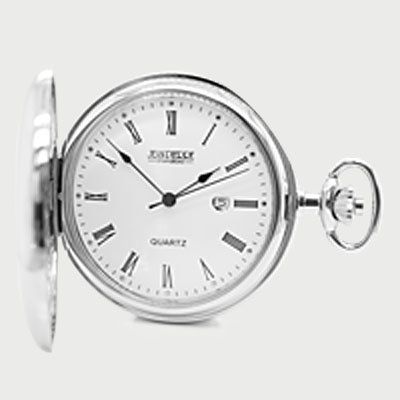
- A movement powered by a quartz crystal. Quartz crystals are very accurate and can be mass produced, which makes them less expensive than most mechanical movements requiring a higher degree of craftsmanship.
R
- Ratchet Wheel
- Toothed wheel prevented from moving by a click pressed down by a spring.
- Regulating Unit
- Made up of balance and balance spring, governing the division of time within the mechanical movement, assuring its regular running and accuracy. This combined action determines the frequency — the number of vibrations per hour — and affects the rotation speed of the different wheels.
- Regulator
- Regulates the functioning of a movement by lengthening and shortening the active section of the balance spring. Positioned on the balance-bridge, it encompasses the balance spring with its two pins near its fixing point on the bridge. Shifting the index moves the pins and, in consequence, lengthens or shortens the portion of the balance spring capable of bringing the balance back, affecting how fast or slow the movement runs. Refined index-regulation systems (from eccentric to micrometer screws) limit error margins to very few seconds per day.
- Remontoir or Constant-Force
- Old term used to denote any mechanism assuring a constant transmission of the driving power to the escape wheel.
- Repeater
- Mechanism indicating time by acoustic sounds. Unlike watches with en-passant sonnerie devices that strike the number of hours automatically, repeaters work on demand by actuating a slide or pusher positioned on the case side. Repeaters are normally provided with two hammers and two gongs: one for minutes and one for hours, with quarters obtained by the almost simultaneous strike of both hammers. The striking work is among the most complex complications.
- Retrograde
- Said of a hand that, instead of making a revolution of 360° before starting a new measurement, moves on an arc scale (generally 90° to 180°) and at the end of its trip comes back instantaneously. Normally used to indicate date, day or month in perpetual calendars, but also seen for hours, minutes or seconds. The retrograde system requires a special mechanism inserted into the basic movement.
- Roller Table or Roller
- Part of the escapement in the shape of a disc fitted to the balance staff and carrying the impulse pin that transmits the impulses given by the pallets to the balance.
- Rotating Bezel
- A bezel that can be turned. Different types of rotating bezels perform different timekeeping and mathematical functions.
- Rotor
- In automatic-winding mechanical movements, the rotor is the part that, by its complete or partial revolutions in response to the movements of the wrist, allows winding of the mainspring.
S
- Sapphire Crystal
- Synthetic corundum crystal with a hardness second only to diamond. Transparent sapphire is the most expensive and durable and is used for scratch-proof watch glasses. A non-reflective coating on some sport styles prevents glare.
- Sapphlex Crystal
- Seiko's trademarked name for a fusion of sapphire and mineral glass crystals.
- Scale
- Graduation on a measuring instrument, showing divisions of a whole of values, especially on a dial or bezel. Scales commonly used in horology relate to devices such as the tachometer, telemeter and pulsometer; measuring starts at the beginning of the event concerned and stops at its end, read directly from the chronograph second hand without further calculation.
- Screw Balance
- Before the invention of the perfectly weighted balance by use of a smooth ring, balances were fitted with weighted screws to achieve the exact impetus desired. Today a screw balance is a subtle sign of quality in a movement due to its costly construction.
- Screw-Down Locking Crown
- A crown which aids water resistance by sealing the crown against the case. The seal is achieved by the matching of a threaded pipe on the case with the crown's internal threads and gasketing while twisting the crown to lock it into place.
- Second Time-Zone Indicator
- An additional dial that can be set to the time in another time zone. It lets the wearer keep track of local time and the time in another country simultaneously. See also GMT and World Time.
- Sector
- See Rotor.
- Self-Winding
- See Automatic.
- Shockproof or Shock-Resistant
- Watches provided with shock-absorber systems (e.g. Incabloc) help prevent damage from shocks to the balance pivots. A retaining spring system assures an elastic play of both jewels, absorbing the movements of the balance-staff pivots when the watch receives strong shocks, with the spring returning them to their previous position. Without such a system, shock forces impact the balance-staff pivots directly, often causing bending or breakage.
- Sidereal Time
- The conventional time standard refers to the sidereal year (defined as an average of 365.25636 days), long considered perfectly regular, with any difference now virtually negligible. The sidereal day is used mainly by astronomers to define the interval between two upper transits of the vernal point in the plane of the meridian.
- Skeleton, Skeletonized
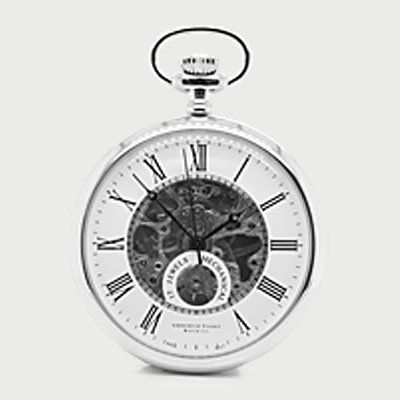
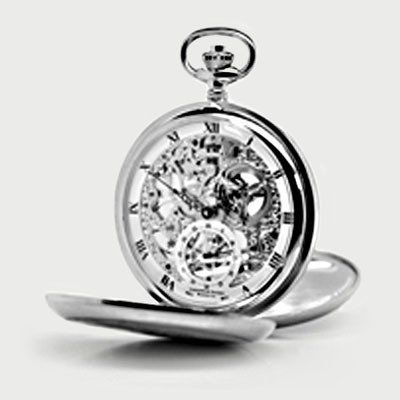
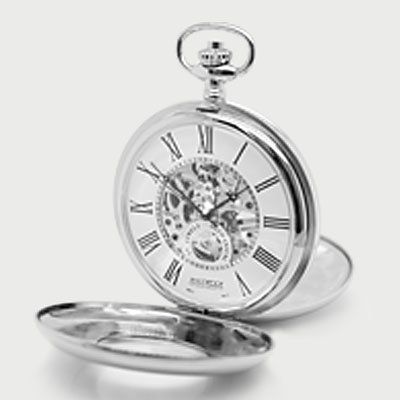
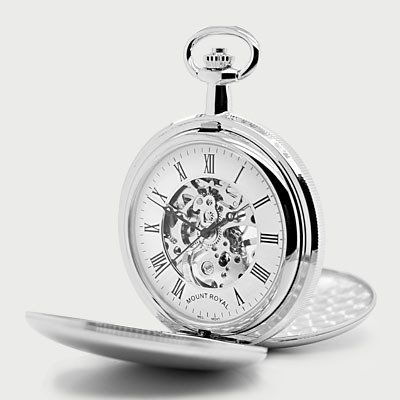
- Watches whose bridges and pillar-plates are cut out in a decorative manner, revealing all the parts of the movement.
- Slide
- Part of a mechanism moving with friction on a slide-bar or guide.
- Small Second
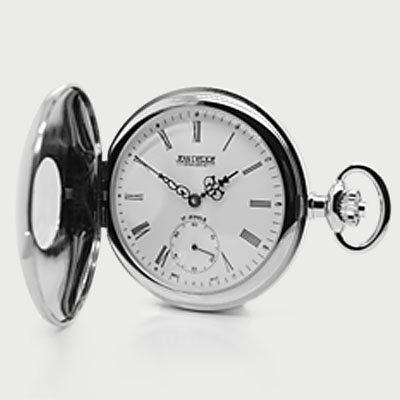
- Time display in which the second hand is placed in a small subdial.
- Snailing
- Decoration with a spiral pattern, mainly used on the barrel wheel or on large full wheels.
- Solar Powered
- A watch that uses solar energy (from any light source) to power the quartz movement. Citizen calls its solar powered watches “Eco-Drive.”
- Solar Time
- The time standard referred to the relative motion of the Earth and the Sun governing the length of day and night. The true solar day is the period measured after the Sun appears again in the same position from our point of observation; because Earth's rotation is not perfectly uniform, the mean solar day is used as an invariable measure, corresponding to the average duration of all days in the year.
- Solstice
- The time when the sun is farthest from the equator: around June 21st (summer solstice) and December 21st (winter solstice).
- Sonnerie (En Passant)
- Function consisting of an acoustic sound, obtained by a striking work made up of two hammers striking gongs at set hours, quarter- and half-hours. Some devices can emit a chime with three or four hammers and gongs. A slide or additional pusher can exclude the sonnerie device or select a so-called grande sonnerie.
- Split-Second Chronograph
- Chronographs with split-second mechanisms are particularly useful for timing simultaneous phenomena that begin together but end at different times, such as sporting events with several competitors. An additional hand is superimposed on the chronograph hand; pressing the pusher starts both, which remain superimposed until the split-second mechanism is blocked, stopping the split-second hand while the chronograph hand continues. Pressing the same pusher again releases the split-second hand, which joins the still-moving chronograph hand and is ready for another recording. The return pusher brings both hands back to zero, provided the split-second hand is not blocked.
- Staff or Stem
- See Arbor.
- Stopwatch
- A watch with a seconds hand that measures intervals of time. When a stopwatch is incorporated into a standard watch, both the stopwatch function and the timepiece are referred to as a chronograph.
- Stopwork
- Traditional device (now obsolete) provided with a finger piece fixed to the barrel arbor and a small wheel in the shape of a Maltese cross mounted on the barrel cover, limiting the extent to which the barrel can be wound.
- Striking Work
- See Sonnerie and Repeater.
- Subdial
- A small dial on a watch face used for any of several purposes, such as keeping track of elapsed minutes or hours on a chronograph or indicating the date. See also Zone.
- Super-LumiNova
- See Luminescent.
- Sweep Second Hand
- A center second hand, i.e. a second hand mounted on the center of the main dial.
T
- Tachometer or Tachymeter
- Function measuring the speed at which the wearer travels a given distance. The tachometer scale is calibrated to show the speed of a moving object over a known distance, shown on the dial (e.g. 1,000, 200 or 100 meters, or one mile). As the vehicle passes the starting point of the measured course, the observer releases the chronograph hand and stops it as the vehicle passes the finishing point; the hand's position on the scale represents the speed in kilometers or miles per hour.
- Tank Watch
- A rectangular watch designed by Louis Cartier. The bars along the sides of the watch were inspired by the tracks of tanks used in World War I.
- Telemeter
- The telemeter scale allows measurement of the distance of a phenomenon that is both visible and audible. The chronograph hand is released at the instant the phenomenon is seen and stopped when the sound is heard; its position on the scale shows the distance in kilometers or miles separating the phenomenon from the observer. Calibration is based on the speed of sound through air (approx. 340 meters or 1,115 feet per second) — useful, for instance, for timing the gap between lightning and thunder.
- Third Wheel
- Wheel positioned between the minutes and seconds wheels.
- Timer
- Instrument used for registering intervals of time (duration, brief times), without any indication of the time of day.
- Time Zones
- The 24 equal spherical zones into which the surface of the Earth is conventionally divided, each limited by two meridians and 15° (or 1 hour) apart. Each country adopts the time of its zone, except for countries spanning more than one zone. The universal standard time is that of the zero zone, whose axis is the Greenwich meridian.
- Titanium
- An environmentally friendly, natural metal that is roughly 40% stronger and 30% lighter than stainless steel. It is hypoallergenic because it is nickel-free, and extremely resistant to salt water and other forms of corrosion, able to withstand extreme temperatures — ideal for water sport enthusiasts. Many titanium watches are further enhanced with a glass coating for increased scratch resistance.
- Tonneau
- Particular shape of a watchcase, imitating the profile of a barrel, i.e. with straight, shorter, horizontal sides and curved, longer, vertical sides.
- Tourbillon
- Device invented in 1801 by A. L. Breguet. This function equalizes position errors due to changing positions of a watch and the related effects of gravity. Balance, balance spring and escapement are housed inside a carriage, or cage, rotating once per minute, compensating for possible errors over 360°. Although not strictly necessary for accuracy today, it remains appreciated as a complication of high-quality watches.
- Train
- All the wheels between barrel and escapement.
- Tritium
- Slightly radioactive material that collects light energy and is used to coat hands, numerals, and hour markers on watch dials to make reading the time in the dark possible. Watches bearing tritium must be marked with the letter T on the dial near 6 o'clock. It is gradually being replaced by nonradioactive materials such as Superluminova and Traser due to medical misgivings and expected governmental regulation of its use.
- Two-Tone
- A term used to indicate that a watch has both “silver” and “gold” tone color, which may or may not be genuine gold or silver.
U
- Unidirectional Rotating Bezel
- An elapsed time rotating bezel, often found on divers' watches, that moves only in a counterclockwise direction. It is designed to prevent a diver who has unwittingly knocked the bezel off its original position from overestimating remaining air supply, since the bezel can only be moved to err on the side of safety. Many divers' watches are ratcheted so the bezel locks into place for greater safety.
- Universal Time
- The mean solar time of the Greenwich meridian, counted from noon to noon. Often confused with the mean time notion.
V
- Variation
- In horology, the term usually refers to the variation of the daily rate, i.e. the difference between two daily rates specified by a time interval.
- Vibration
- Movement of a pendulum or other oscillating body, limited by two consecutive extreme positions. In an alternate (pendulum or balance) movement, a vibration is half of an oscillation. The number of hourly vibrations corresponds to the frequency of a watch movement, determined by the mass and diameter of the balance and the elastic force of the balance spring, and determines the steps of the second hand. Until the 1950s, wristwatches mostly worked at 18,000 vph; later, higher frequencies were adopted for lower irregularity. Today the most common frequency is 28,800 vph, balancing good precision with fewer lubrication issues than extremely high frequencies such as 36,000 vph.
W
- Water Resistant or Waterproof
- A watch whose case is designed to resist infiltration by water (e.g. 3 ATM, corresponding to a conventional depth of 30 meters; 5 ATM, corresponding to 50 meters).
- Wheel
- Circular element, mostly toothed, combining with an arbor and a pinion to make up a gear. Wheels are normally made of brass, while arbors and pinions are made of steel. The wheels between barrel and escapement make up the so-called train.
- Winding Stem
- Element transmitting motion from the crown to the gears governing manual winding and setting.
- Window
- Aperture in the dial that allows reading of the underlying indication, mainly the date, but also indications concerning a second time zone or jumping hour.
- World Time
- Additional feature of watches with a GMT function, displaying the 24 time zones on the dial or bezel, each referenced by a city name, allowing instantaneous reading of the time in any country.
Z
- Zone
- Small additional dial or indicator, positioned or placed off-center on the main dial, used for the display of various functions (e.g. second counters).
- Zodiac
- Circular belt with the ecliptic in the middle, containing the twelve constellations through which the sun seems to pass in the course of a year.